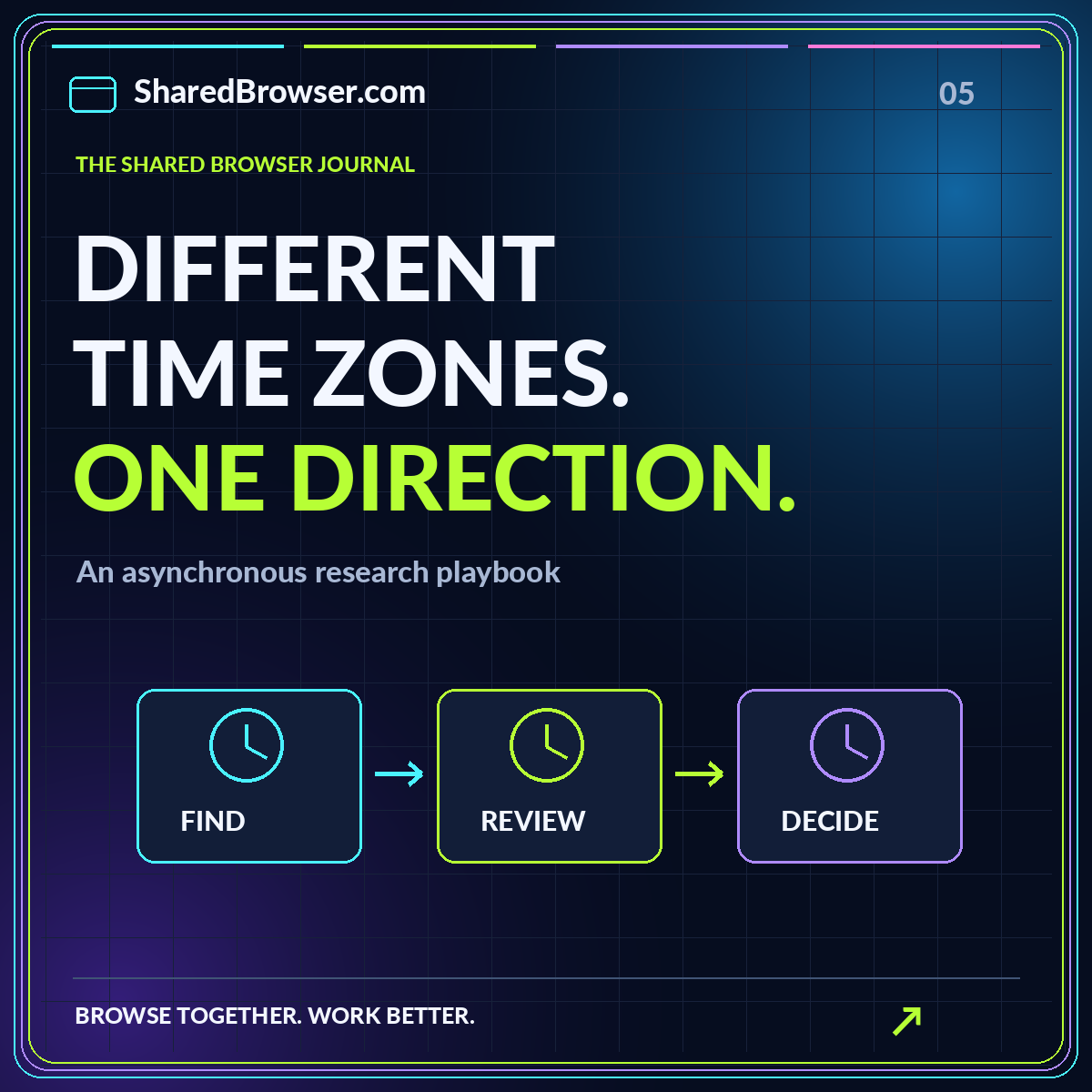
Asynchronous research is not simply a meeting stretched across a chat thread. It is a way of making questions, evidence, and decisions understandable to people who are not present at the same time. Without that structure, one person drops a link, another reacts hours later, and the team loses track of which question the discussion was meant to resolve.
A shared browser workspace can provide a useful organizing model, but the important work is editorial: stating the task, attaching context, and making the next action explicit. This guide describes an asynchronous research process for a small remote team. It focuses on ordinary project decisions and can be adapted to the approved collaboration tools your team already uses.
Begin with a decision brief
Write a short brief that identifies the decision, its owner, its deadline, and the constraints that matter. “Research onboarding tools” is too broad to guide independent work. “Compare two approaches for giving new colleagues access to the team's reference material without exposing unrelated documents” is narrower and makes the evaluation criteria easier to define.
Include what is out of scope. Otherwise, well-intentioned contributors may spend time investigating adjacent questions that do not help the current decision. State whether the team is exploring options, validating a shortlist, or preparing an implementation plan. The expected evidence differs at each stage. A clear brief lets people work independently without requiring them to guess what kind of answer will be useful.
Break the question into independent research tasks
Divide the brief into questions that can be investigated separately: access boundaries, portability, usability, and maintenance responsibilities, for example. Give each question a named owner and a visible place for findings. Avoid assigning the same broad question to everyone unless independent comparison is an intentional part of the method. Otherwise, duplicate searches can look like progress while leaving important gaps untouched.
Define the expected output before work begins. A useful contribution might be a short conclusion, two relevant sources, a limitation, and one unresolved question. The number is a planning choice rather than a universal rule. What matters is that contributors know the level of detail required. Keep a path for someone to flag that their assigned question is poorly framed or cannot be answered from available evidence.
Make the work visible without monitoring people
Track research items rather than people's online presence. A task should show its owner, current state, and next dependency. Presence indicators are not evidence that a question has been answered. Neither are the number of tabs opened or messages sent. Ask for a visible artifact that another person can evaluate: a note, a comparison, or a documented uncertainty.
As an example of a structured project record, GitHub's documentation about Projects describes organizing work in views such as tables and boards with configurable fields. You do not need that particular tool to use the underlying pattern. A simple approved document can also distinguish research tasks, findings, decisions, and ownership when the team maintains those distinctions consistently.
Use a common evidence-note format
Ask contributors to separate the source's statement from their interpretation. The note should identify the resource, the relevant section, the observation, and its implication for the project. Add a confidence qualifier when needed: confirmed in the documentation, observed in a sample test, or still awaiting verification. These labels should describe how the finding was obtained, not create an appearance of scientific precision.
Keep the original question beside the note. A reader should not have to search through a conversation to understand why the source matters. When evidence contradicts another contribution, preserve the disagreement and identify the conditions that differ. One source may concern a paid tier while another describes a basic configuration. The shared bookmark library guide provides a complementary way to maintain the underlying references.
Design handoffs for the next reader
End each research session with a brief handoff: what was checked, what changed, what remains unclear, and what should happen next. Link to the current record rather than copying a new version into every message. A handoff should give the recipient enough context to continue without needing the previous contributor to be awake or immediately available.
Avoid vague requests such as “please review” when a specific response is needed. Ask whether the evidence supports a stated conclusion, whether a missing constraint changes the comparison, or whether the proposed next step is authorized. Include a response date when it affects the project. A precise request makes asynchronous collaboration more respectful because the recipient knows what a complete answer looks like.
Create a review window instead of constant interruption
Set a point at which contributors should have their findings ready and reviewers should respond. This helps distinguish useful updates from messages that merely interrupt focused work. A review window does not forbid urgent escalation; it gives ordinary questions a predictable route. Make the urgent route explicit so people do not label every uncertainty as an emergency.
During review, check the reasoning before polishing the presentation. Does each conclusion follow from the cited evidence? Are important constraints missing? Did the team treat a provider's claim as an independently verified result? Leave comments on the specific finding rather than restarting the entire discussion in a separate thread. The project record should become clearer as review progresses, not fragment into parallel accounts.
Use live conversation for bounded ambiguity
Some disagreements are faster to untangle together. Schedule a focused conversation when participants interpret the same evidence differently, when the scope has changed, or when a decision owner needs a direct explanation of tradeoffs. Send the relevant notes beforehand and identify the question the conversation should settle. Do not turn a research review into an unprepared tour of everyone's browser tabs.
Afterward, update the written record. People who could not attend should see the same decision, rationale, and unresolved concerns as those who were present. A recording may supplement that record, but it should not be the only route to understanding the outcome. Our co-browsing comparison explains when a shared visual session adds value and when a collection of well-explained sources is enough.
Keep access and attribution intentional
Remote work often involves references spread across several systems. Confirm that intended reviewers can open the documents they need without broadening access unnecessarily. Use the approved request process for restricted resources. Do not solve a handoff problem by copying private material into an unrestricted workspace or by sharing a personal account.
Attribute contributions and sources so the team knows whom to ask about a finding. Attribution is not about assigning blame for uncertainty. It is a route back to the context of the work. When a contributor leaves the project, transfer maintenance responsibility for important notes and collections. The remote-team use case shows a compact structure for owners, evidence, open questions, and decision records.
Close the loop with a decision note
A completed research process should end with a decision or an explicit explanation of why the decision is deferred. State the chosen approach, its main tradeoffs, the evidence that mattered, and the conditions that would justify revisiting it. Identify the next action and its owner. Archive alternatives with enough context that the team does not repeat the same investigation without reason.
Asynchronous research works when the record carries the context that a meeting would otherwise carry. Start with a narrow brief, assign answerable questions, write evidence notes that stand alone, and use precise handoffs. Add live conversation where it resolves a specific ambiguity, then return the outcome to the shared record. The goal is not fewer conversations at any cost; it is fewer conversations spent reconstructing what the team already learned.